Touch a picture to learn
more
Harmonic
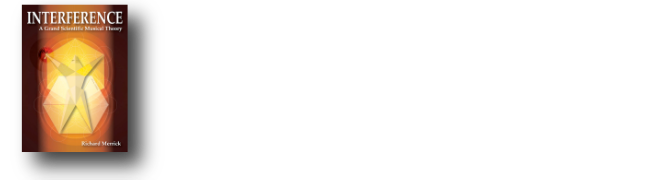
Interference Theory represents a major breakthrough
in our understanding of music and perception. Developed
from a moment of insight thirty years earlier, this theory
explains how harmonics combine to form the same geometrical
patterns in both sound and the human anatomy, triggering
emotions according to phase alignment.
Based on this theory, the historical record suggests
ancient civilizations understood music perception in much
the same way, even developing an advanced harmonic science
and spiritual cosmology from it. Suppressed for hundreds of
years by anti-pagan religious doctrine, only remnants of
this ancient science can be found today hidden inside
mythologies, religious symbolisms and the secret
fraternities. Known as Musica Universalis or the
Audible Life Stream, the physics of music
perception was once the theory of everything.
Each book is a journey into this forgotten musical
worldview. They seek a deeper meaning in nature than that
taught in our schools, laboratories and churches. The kind
of meaning most want, but can never find. A meaning
protected from subjective opinion and learned
behavior—beyond the dogma of culture and faith. A
philosophical meaning that explains our place at the
razor’s edge between order and chaos, circle and spiral,
the limited and the unlimited. A place where music might
become the harmonic science it once was and should become.
Like some inverse reflection by painter Rene Magritte, I am
your humble observer in this quest. I bring a human element
to the method of science and a rationale to the aesthetic
of art. My words form neither a scientific paper nor a
musical treatise. They are inadequate for both, yet perhaps
adequate for the space in between. This is the space that
interests me and the space that I believe holds the most
promise for the future. This is the model of music harmony
that turns out to be the model of everything.
Richard Merrick
December 2010