


The Suppression of Ancient Harmonic Science
Three years ago I decided to return to a research project in music perception that I had postponed nearly thirty years earlier. It seems time had not diminished my curiosity about how we are able to organically measure the degree of dissonance and mentally anticipate the direction of resolution in music harmony.
My original work in this area had taken me deep into mathematics and computer simulations in search of an explanation. Now, armed with the scientific method, powerful computer tools and access to the world's latest research, I was sure that I could determine once and for all whether our perception of music was something organic or nothing more than cultural conditioning. I had no idea that what I was about to learn would shake the very foundation of my 21st century worldview.
Slowly but surely I began to put the pieces together. From a wide array of scientific research in music cognition, neurophysiology, genetics, acoustics, quantum physics and my own calculations and experiments, I developed a set of principles and mathematical models to explain how we recognize and enjoy music. Naming this system harmonic interference theory, I found a way to show how harmonics play a common role in both sound and the structure of our anatomy.
The theory proposes that life grows as a balance between resonance and damping just like a vibrating string and that music perception is a built-in pattern matching between the harmonic geometry of sound and identical structures in the ear and brain. It is from this organic pattern matching process that the musical qualities of consonance, dissonance, tension and resolution can be defined mathematically and then visualized geometrically as crystalline and quasi-crystalline structures. While it sounds like science fantasy, I came to the very real conclusion that the entire human body was a kind of crystallized musical light.
The Vitruvian Model
Once I had convinced myself of the existence of harmonic properties in human physiology, I found myself drawn to Leonardo Da Vinci's popular illustration of the Vituvian Man to see what he might have known. I learned that the circle and square surrounding the Vitruvian Man represented the mathematical 'squaring of the circle' whereby the perimeter of the square is drawn equal (as near as possible) to the circumference of the circle. Proposed first by Roman architect Marcus Vitruvius Pollio in the first century BC, the squaring of the circle was intended to represent the harmony and balance in the ideal human form.
As I pondered what this could mean, it occurred to me that the circle implied an inside-out resonance of cells in the body while the square represented an outside-in damping effect to contain the outward push of cellular resonance. Like the standing wave and ring models in my interference theory, it dawned on me that all organic life could be defined as energy exploding outward into space that is then pushed back inward into specific shapes, presumably depending on which harmonic proportions are emphasized by DNA as a quantum resonator.
Looking back on it, this was a very difficult thing for me to accept at first. Like every student, I had been taught from the earliest age that space was a complete and utter void. Yet, I simply could not resist the logic of life as a form of resonance and space as a kind of damping container.
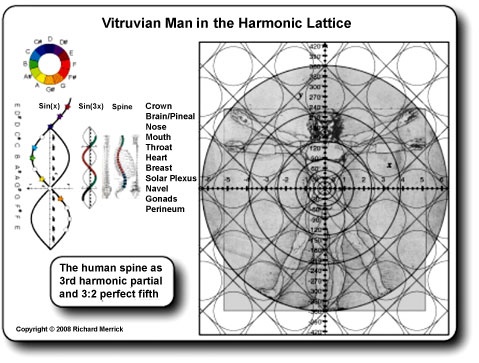
Using this as a hypothesis, I decided to find a way to measure resonance and damping in the Vitruvian model. To do this, I overlaid a lattice of right-angled standing waves on the Vitruvian figure. When I scaled the lattice such that the circle radius was exactly equal to 2 PI, I was surprised to find that the proportion between the circle and square could be expressed very simply as PI divided by the square of the golden ratio (or ∏ / Φ^2). Could this be pure coincidence? While both of these mathematical constants are irrational and infinite, the ratio between them does converge to the rational ratio 12:10 as 3.14159 / 2.618033 ≈ 1.2.
The moment I saw this, I realized that harmonics really could account for our body structure. We have ten fingers and toes at the extremities (where cellular damping is presumably greatest), yet at the same time we have twelve major articulated joint groups in the body and twenty-four vertebrae in the spine (where cellular resonance must be greatest).
Pursuing this line of thought, I decided to add a recursive growth dimension to the lattice (creating what is called a 'Hilbert space'). This was incredibly accurate in predicting each of the key plexus points in the Vitruvian model, convincing me that our bodies (and all life) must resonate or grow into the containment geometry of space. And just to confirm this, I reverse engineered the Vitruvian model from the inside out by recursively building up each part of the body mathematically as if it were growing in space. The implications were absolutely mind-blowing for me, since it seemed to confirm that space was somehow interacting with the structure of life. But this was only the beginning.
Hidden symbols, suppressed knowledge
I began to notice how the harmonic lattice could also contain other things, like ancient religious icons, sacred geometrical patterns and the mysterious symbols used by various esoteric fraternities. Not being a member of any such organization myself, I waded through the literature on these topics to get an idea of where these secret orders came from and what their symbols could mean.
I found an unbroken current of knowledge through all of them tracing back to the Egyptian Flower of Life pattern (6th century BC) and its components, particularly the geometries of Metatron's Cube and the Vescia Piscis, which all fit perfectly into the Vitruvian harmonic model. I also noticed that the Hebrew Tree of Life fit within this musical lattice, aligning with the seven points of the Hindu chakra system! Even the Gnostic cross used by the Rosicrucian Order - a cube unfolded into 3 x 4 squares - fit nicely into the lattice, transforming the Vitruvian Man into a kind of archetypal crucifix. Could something like this have been the pre-Christian meaning of the cross, I wondered?
As my belief in Western science began to falter, I asked myself how this simple harmonic lattice could be so completely absent from general public awareness. Why is this not common knowledge? Why is this not part of science, music, history and our entire educational system? Why would it not at least rate as a 'fun fact' in a sidebar in Popular Science or on an anatomy poster at the doctor's office? And above all, why would the Church not want people to know all about it? After all, it could be taken as proof of a sacred ordering principle in nature, inferring the existence of a cosmic intelligence (call it what you will).
So, I reoriented my study of history from this new perspective, and it quickly became obvious to me why we know virtually nothing of this lost knowledge.
I discovered that harmonic philosophy had long been associated with paganism (the belief of God in nature) and that the Roman Catholic Church had worked very hard over a period of a thousand years to suppress it through canon law. This was the reason the tritone interval of a half-octave, nicknamed Diabolus in Musica or Devil in Music, had been banned from sacred music in 1234 AD by Pope Gregory IX (and still maintained to this day). The Church seemed well aware that the tritone could reveal the symmetry in music harmony and open the door to the 'carnal knowledge' of harmonics in the body and elsewhere in nature.
As the most powerful force in the Middle Ages, the Roman Catholic Church was very successful in establishing and promulgating a franchise system whereby the faithful could only reach God through the Church (and its iconic brand) rather than through the study of self and nature. It was through this marketing and distribution network that the Church was able to social engineer vast populations by regulating admission to the afterlife.
Through the power of guilt, fear, torture and war against pagan influences from the Middle East, the medieval Church struggled to bring under hand a violent and turbulent Europe. The last thing the Church needed was a resurgence of Egyptian Hermeticism, Hebrew Kabbalah or neo-Pythagoreanism to interfere with its plan. Such pagan harmonic theosophies were a clear and present danger to the Church and its project of social control. Harmonic ideals, often represented by the Pythagorean pentagram or Hebrew hexagram, were cast by the Church as evil pagan symbols and associated with satanic worship, witchcraft and occult rituals.
Those who studied harmonic properties in numbers, geometry and astronomy, such as the Dualist and Gnostic Cathars in southern Europe during the 11th, 12th and 13th centuries, were threatened, executed or exiled, forcing many to roam the countryside as 'gypsies' (a pejorative form of Egyptian). The Knights Templar, the primary keepers of the Egyptian temple mysteries, were then hunted down and murdered by the Church (on Friday 13, 1307) with a few fleeing to far-flung places like northern Scotland. In these remnants of the Egyptian mystery school were the seeds of Rosicrucianism, Freemasonry and other 'secret societies' - all of which were founded on the study of harmonics in numbers and geometry. This said, few adherents today are the least bit aware or interested in harmonic science, opting instead for the benefits of a fraternal network of friends and the occasional community service project.
But while an honest look at European history seemed to explain how and why harmonic principles had disappeared from Western religion, it still did not answer why science, as the presumed pillar of empirical truth in the world, did not eventually return to harmonic science as a unifying field of study. So I dug a little deeper and here is what I found.
The anti-harmonic campaign
During the run up to The Enlightenment in the late 17th and 18th centuries the 'scientific method' had actually been designed to discourage the study of harmonics and its corresponding natural philosophy known as musica universalis.
I learned that the exclusion of music and pagan harmonic principles from modern science was first suggested in a letter from the astronomer Galileo to his daughter, apparently prompted by his inner conflict of faith and understandable desire to avoid torture and imprisonment by the Italian Inquisition.
Supported by Newton, Descartes and others who also wished to find a way to coexist with the Church during this period, the separation of harmonic study away from mathematics and science into 'the humanities' became more and more institutionalized as the scientific method became universally accepted. In time, new generations forgot all about harmonics as a unifying property in nature - even taking up the cause of science to discredit any remaining harmonic theories as 'smelling of the pulpit' (a twist of irony).
In the early 20th century, this anti-harmonic campaign reached its zenith in the Michelson-Morley experiment 'proving' that space was an empty void with no intrinsic structure or measurable effect on matter. This belief was quickly accepted as the cornerstone of 20th century scientific thought and education, elevating Darwin's theory of natural selection (with the occasional accidental mutation) as the sole explanation for why life takes the forms it does. Only in recent years has this experiment been shown to be misleading and even false by much more sophisticated instruments indicating space does have a measurable effect on matter.
 But, like most everyone these days, I grew up in a society and educational system that still denies the existence of any structuring property in the vacuum or how it could play a role in the formation of life. Even the smartest and best-educated people happily accept the contradictory belief that space is both curved (Einstein) AND an empty void. No one even thinks to raise the question of how it is that nothingness could be curved or, for instance, how cellular resonance into a structured space might explain why our bodies have ten fingers instead of, say, eight or fourteen. The avoidance and outright ridicule of a geometrically structured space (an 'aether') remains a point of great disagreement and debate today, not only slowing progress in virtually every field of science but also hiding a very important truth from society. What is that truth?
The truth is that for the past 350 years a complicity of convenience has existed between the institutions of Western religion and science to avoid any mention of harmonics. This unspoken tradition continues to spill over into society to this day, fragmenting Western culture and ideologically supporting unnatural and unsustainable political, economic and environmental policies.
With the study of harmonics no longer present in our schools and churches as it once was, we push each generation further and further away from the idea that mankind should seek to follow the harmonic processes at work throughout nature.
Without any coherent social and cultural model, most presume the universe to be a cold, meaningless and random environment within which only accidents or brute force applies. Life itself is seen as a quirky accident in a hostile world, making it easy to agree with people like neo-Darwinist Richard Dawkins that selfishness is the winning strategy for survival. Under the widespread presumption of a random and violent universe, existential nihilism has become the popular consensus.
Toward a new renaissance
This all said, I do think there is hope in the bright light of quantum physics. While the rest of science continues to be powered by Newtonian machinations, quantum theory quietly proposes a cosmos composed of coherent harmonic waves crystallizing into matter inside a polarized cubic space lattice (like a physical hologram). The Schrödinger wavefunction and 'particle in a box' model of quantum mechanics are just another way of describing the harmonic structure of space - no different than the physics of a guitar string. Still, with the long tradition of avoidance, any notion of a coherently structured space has yet to make its way into standard science curriculum while remaining mostly absent in other fields of science.
But if the study of harmonics ever were allowed back into the educational system, we could see a cultural Renaissance that would make even Leonardo's naked Vitruvian Man blush. T-shirts might implore us to 'Bring back the Aether' while religious bumper stickers proclaim, 'Get in touch with your inner archetype!' The full intersecting circles of the Vesica Piscis would suddenly appear in place of just the fish part on all those SUVs. Even Einstein's 'everything is relative' would sound tired, replaced by the neo-Pythagorean catch phrase 'everything is proportional.'
Fashion would explode with 'sacred geometry' and Egyptian styles could make a comeback. The idea that an archetypal structure in space actually shapes flowers, insects, fish, birds, pets and people would be irresistible and, I think, difficult to suppress once the meme was released.
Driven by grassroots awareness, hardened scientists might find common ground with the modern theosophical movement. They might accept life as non-accidental and geometry as something sacred. They might even learn to embrace the spirituality of the ancient Hindu Anu - the ultimate quanta of material structure - some say exists deep inside every atom. Western religion might finally make peace with these pagan ideals and finally admit (with a wry smile) that they knew all along the Holy Ghost was but a blueprint for Man in the fabric of space. And as harmonic principles once again took root in the collective consciousness, maybe our off-balance governments would finally consider modeling their policies on the coherence demonstrated so beautifully in the human form.
Personal conclusion
I know - many things would have to change for this to ever occur. Textbooks must be rewritten, curriculum revised, educators reprogrammed, social policies adjusted and harmonic principles accepted (at least in part) by people in positions of power who really want the truth to come out. Will it ever happen? I hope so and soon!
In the mean time, I'm not waiting around for all those scientists, historians, theologians and musicians to build me a new religion. I'm going to listen to a little Bach, enjoy the musical universe we live in and do my part to try and change things for the better. This is my new unapproved harmonic worldview.
Selected References
• Levin, F.R. (1994), 'The Manual of Harmonics of Nicomachus the Pythagorean,' Phanes Press, ISBN 0-933999-42-9, pp. 76-139.
• Livio, M. (2002), 'The Golden ratio: The Story of Phi The World's Most Astonishing Number,' Random House, Inc., ISBN 0-7679-0816-3, pp. 183 - 187.
• Comotti, G., (Original 1979), 'Music in Greek and Roman Culture,' The Johns Hopkins University Press, 1991, ISBN 080184341X
• Prestini, E., 'The Evolution of Applied Harmonic Analysis: Models of the Real World,' Birkhauser, Boston,ISBN 0817841254, p. 16.
• McKinnon, J. (1990), ed. 'Antiquity and the Middle Ages' Englewood Cliffs, NJ: Prentice Hall
• Wiener, P.P., 'The Dictionary of the History of Ideas,' New York, NY: Charles Scribner's Sons, 1973-74, pp 261, vol. 3
• Heyrovska, R., 'The Decisive Role of the Golden ratio in Atomic Dimensions,' J. Heyrovsk_ Institute of Physical Chemistry, Academy of Sciences of the Czech Republic, Dolej_kova 3, 182 23 Prague 8, Czech Republic.
• Rossing, T. D. (1982), 'Chladni's Law for Vibrating Plates.' American Journal of Physics. Vol 50. no 3. March, 1982.
• Jenny, H. (1967/ 1974), 'Cymatics.' Macromedia Publishing, Vol. 1, 1967, Vol 2., 1974. ISBN: 1-888-13807-6
• Waller M. D. (1955), 'A Study of Powder and Granular Ridges in a Sound Field,' 1955 Proc. Phys. Soc. B 68 462-471
• Waller, M.D. (1961), 'Chladni Figures; a study in symmetry,' London, G Bell, 1961
• Ashton, A. (2003), 'Harmonograph; A Visual Guide To The Mathematics of Music,' Wooden Books Ltd and Walker Publishing Company, Inc., 2003, ISBN: 0-8027-1409-9.
• Ball, P., 'Geometric whirlpools revealed,' Nature.com, May 2006.
• Haramein, N., Rauscher, E.A., 'Collective Coherent Oscillation Plasma Modes in Surrounding Media of Black Holes and Vacuum Structure - Quantum Processes with Considerations of Spacetime Torque and Coriolis Forces,' The Resonance Project Foundation, www.theresonanceproject.org.
• Haramein, N., Rauscher, E.A., 'The Origin of Spin: A Consideration of Torque and Coriolis Forces in Einstein's Field Equations and Grand Unification Theory,' Noetic Journal CD Rom, ISSN# 1528-3739., July 2006.
• Lee, L., 'Acoustic Experiments in the Great Pyramid,' The Laura Lee Show, 2007.
• Reid, J., booklet entitled 'Egyptian Sonics,' 2007.
• Richter, J. P., 'The Notebooks of Leonardo Da Vinci,' Oxford University Press, USA; New Edition (1998).