


The Frozen Music of Rosslyn Chapel
"I call architecture frozen music."
Johann Wolfgang von Goethe
German writer, scientist, color theorist and Freemason
In a case of art imitating art, a press release earlier this year (2006) announced that “frozen music” had been found hidden in the architecture of the 15th century Rosslyn Chapel - the same chapel popularized at the end of Dan Brown’s book The Da Vinci Code. The chapel’s puzzling architecture remained unexplained for well over 450 years until it was deciphered by Thomas Mitchell and his son Stuart Mitchell earlier this year.
The announcement explained that a total of 215 “musical cubes” in the pillars and arches of Rosslyn Chapel were found to match 13 unique geometrical sound patterns, known as Chladni figures or Cymatics. These patterns are produced when a metal plate is sprinkled with salt or powder and vibrated by sound frequencies. Documented first by Ernst Chladni in 1787, the patterns can range from primitive polygons like triangles, pentagons and hexagons to beautiful Mandela-like patterns, depending on which frequencies are used (see Music of the Quantum Lattice). The Mitchells found that each of the cube patterns matched specific musical tones that were organized into vertical groups around the chapel’s pillars. Using these tones to form a melody, the men then composed and staged the premier performance of “the Rosslyn Motet” on May 18, 2007 inside the chapel.
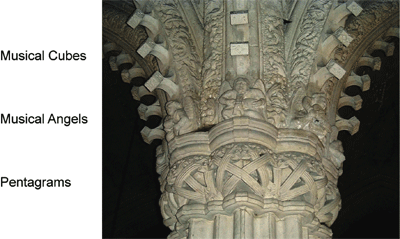
To help them decode the cubes, they found a special “stave angel” figure carved into one pillar that was holding a musical staff and pointing to the three tones {A, B, C} on the treble clef. These particular tones corresponded to some of the cube patterns.
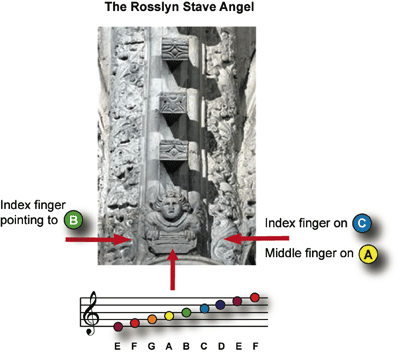
The angel points to B with his right hand and to A and C with his left. This was taken to indicate that the music was in the key of C major, or relative A minor, with the “leading tone” B balanced symmetrically in the center. From this, each of the cube patterns was matched against a particular frequency using a square Chladni plate tuned to C. The resulting pitches were ordered from bottom to top, left to right around the columns beginning with the stave angel to produce a haunting melody.
While this is a truly amazing story, it raises the deeper question of who designed the chapel, why did they hide this music in the chapel architecture and what does it mean?
Founded in 1446 by William Sinclair, 1st Earl of Caithness of the St. Clair family, Rosslyn chapel was constructed to include numerous symbols now attributed to the Knights Templar and esoteric society of Freemasonry. According to Robert Freke Gould, author of the History of Freemasonry, “Masonry is regarded as the direct descendant, or as a survival of the mysteries…of Isis and Osiris in Egypt.” The chapel’s puzzling architecture was designed by Sir Gilbert Hay, one of the most learned and intellectual minds of the 15th century, under the direction of William Sinclair. Both men are believed to be Jewish/Christian Ebionites connected to the Essene mystery school, a precursor to modern Freemasonry.
As this chapel clearly demonstrates, the resonance patterns created by reflected sound waves were well understood long before Chladni’s official scientific discoveries in the 18th century. In fact, knowledge of the geometry of sound can be traced back to ancient Chinese and Egyptian wisdom and was preserved in the Hermetic secrets of Freemasonry. Music, harmonic resonance and geometric symbolism are all integral to Hermetic beliefs about the structure of the cosmos and all life. Hay and Sinclair apparently sought to preserve this knowledge in Rosslyn Chapel.
In looking at the columns, we see a series of pentagrams supporting the musical angels. But oddly, the angels replace the missing top triangle in each pentagram. Cross-referencing this to Hermetic lore, this missing triangle is the very same “golden” triangle symbolic of resonance. The question is how can this particular triangle, as part of a pentagram, be considered resonant and why was it so important that it should be carved into a stone chapel?
A golden triangle, taken from the pentagram, has angles measuring 36 X 72 X 72 degrees and sides in proportion to the golden ratio (~1.61803). There is a 3-degree difference between the top angle of the golden pyramid and the highest 33rd degree of Freemasonry, representing a difference ratio of 3:180, or 0.01666667. This ratio can be represented more simply by the 5:3 ratio of a just tuned major sixth - the most pleasing and spectrally resonant interval in music. By replacing the top golden triangle of the pentagram with the heavenly angels, the designers of the chapel may have been symbolizing the resonant 3-degrees separating mankind from the “Great Architect”. As an additional bit of word play, the designers even replaced the triangle’s top “Angle” with a musical “Angel”, both of which begin with the letter “A,” itself derived from a golden triangle once used to represent the Alpha and Omega.
We can now see how the angels (or “putti”) sitting on the pentagram symbolized the geometry and numerical ratios of resonance passed down from Egyptian theosophy. But why would such knowledge need to be hidden in this way?
To the medieval Catholic Church, Egyptian ideas of resonance were considered part of a Pantheistic belief of God in nature and were a direct threat to the Christian belief of God outside of nature. As a result, the geometry of the pentagram and certain resonant intervals were considered unfit for use in the Church. This was especially true for the musical interval of three whole tones (six half-steps) known as the tritone.
Known as Diabolus in Musica, or the Devil in Music, the tritone is very strongly related to this ancient understanding of resonance, sharing what we will call for now, an “inverse harmonic relationship” with a consonant major sixth. The Rosslyn stave angel emphasizes this fact by pointing to the part of the tritone interval known as the “leading tone”. As a matter of fact, the melody in the cubes emphasizes the tritone in a way that would have been unacceptable to the Catholic Church in the 15th century.
Banned by Pope Gregory IX in 1234, the tritone was and still is outlawed in Catholic music. As a result, the Freemasons hid their use of this forbidden interval by encoding it as cymatic symbols in the chapel architecture. This was their way of preserving what they considered sacred Egyptian knowledge at a time when Europe was hostile to such beliefs. But there is another twist to this story that takes the concept of resonance to an even higher level of theosophical symbolism.
While there are 13 angels corresponding to the 13 unique cube patterns, there are also 8 dragons whose tongues wrap around the “Tree of Life” carved at the bottom of the pillars. Together, the angels and dragons symbolically represent the Fibonacci ratio of 13:8 or 1.625. This proportion happens to be the first ascending Fibonacci ratio not found as a resonant interval in the harmonic series. This begins the convergence of the remaining Fibonacci ratios towards the golden ratio (~1.61803) found in the pentagram and golden triangle.
It is a little known fact that the ratios of adjacent numbers in the Fibonacci series beginning with 13:8 = 1.625 creates a natural damping effect in the standing wave of a musical tone or other coherent vibration. As each ascending Fibonacci ratio gets closer to the infinite golden ratio, the damping effect increases, thereby canceling all fractional waves and leaving only the whole number harmonics to vibrate sympathetically. This damping effect is used extensively in the design of speaker enclosures and theaters, usually approximated as 1.62 X 1.0 X 0.62 to cancel reflection. Harmonic waves simply cannot resonate at or near the infinite frequency proportion of the golden ratio. The dragon, as the mythical serpent holding secret knowledge in the Underworld, represents this anti-harmonic damping effect in nature which is counterbalanced by the angel’s symbolic resonance.
This brings us to yet another revelation about Rosslyn Chapel. In reviewing the chapel’s dimensions, the length is exactly twice the breadth while the height-to-length ratio is equal to the golden mean. Furthermore, the length of the choir section taken as a proportion to chapel length is a 5:3 major sixth. Since a major sixth is the most resonant interval possible, the choir acts as a maximally resonant chamber in the horizontal direction while damping out reflected standing waves in the vertical direction. In this way, the chapel designers designed a perfectly attenuated chamber that amplified voice and music while minimizing echoes. Perhaps this was also intended as an acoustical symbol that could “thaw” the frozen music in the architecture.
The architecture of Rosslyn Chapel blends the mythological symbolism of alpha-omega or good vs. evil into a musical balance of harmonic resonance and anti-harmonic damping. The secret symbol for harmonic damping can be found today in the “007” moniker taken by Ian Fleming from John Dee, a 16th century original secret agent to Queen Elizabeth I, self proclaimed “angelic-alchemist” and hermetic mathematician very familiar with harmonic proportions. We also find it in the persistent negative symbol for resonance - the Christian “mark of the Beast” 666.
But the chapel designers suggest a more balanced interpretation of this symbolism. The 215 musical cubes in the chapel total one less than 216, the ancient Hebrew number for God. It is said that finding the missing code for this number - six cubed or 6*6*6 - will trigger the Messianic Age of peace. With this, everything in Rosslyn Chapel seems intended to replace the misguided symbolisms of evil with truth and hope.
Opposing forces of resonance and damping are everywhere in nature: the spacing of electrons in an atom, averaged interplanetary orbits, branching patterns in plants and the joint spacing in animals that enable articulated movement. Without this duality, nothing could vibrate, move or even live. Passed down from Egypt and the Orient, driven underground into the esoteric brotherhoods, these fundamental harmonic principles are the very definition of sacred. What could be more appropriate for any sacred temple space than the harmony of nature?